Odders Lab
Chess Club
Checkmate, Controllers: How Odders Lab Added Hands and Mixed Reality to Chess Club on Meta Quest
We sat down with Jaime Pichardo García of Odders Lab to discuss how they evolved Chess Club with hand tracking, mixed reality, voice commands, AI opponents, PvP, and daily puzzles. Watch the full interview on YouTube.
Turning the most played game in history into VR and mixed reality takes more than putting a board in a headset.
For Odders Lab, the opportunity was not to reinvent chess. It was to make chess feel natural, social, and immersive on Meta Quest.
"Chess itself needs no introduction, but how we tackled it with Chess Club is what makes it special," Pichardo García says. "From classical chess pieces all the way to fully animated characters, enjoy the most played game in history using hands, controllers, or even voice commands, either in fully immersive VR or a really well done mixed reality mode."
The result is Chess Club, a strategy game where players can sit across from an opponent in VR, practice against AI, compete in PvP with ELO-based matchmaking, solve daily puzzles, or place the board on their real table in mixed reality and move pieces with their hands.
Chess Club brings chess into VR and mixed reality with hand tracking, controller support, voice commands, AI opponents, PvP, ELO ranking, and daily puzzles.
Since launching on June 29, 2021, Chess Club has grown across Meta Quest and other platforms. Over time, the game has reached more than 100,000 installs and more than 1,200 ratings and reviews with a 4-star average across platforms.
But this story is remarkable because of its longevity. Chess Club is a long-running title that stayed relevant by adopting new platform features when they made the experience better.
Mental Gymnastics
Odders Lab began as a spin-off from an eHealth company called Oblumi. The team first jumped into VR with OHSHAPE, a rhythm fitness game that helped define the studio's early identity.
"We've always been at the crossroads between fitness and games," Pichardo García says. "And what muscle is more important than our brain?"
That line gets to the heart of how Chess Club fits into the Odders portfolio. The studio may be known for movement, rhythm, and physical play, but Chess Club let Pichardo García explore a different kind of training.
Chess Club became Odders Lab's "fitness for the brain" story: a classic strategy game rebuilt for a medium where presence, embodiment, and social connection could change how people experience the board.
The original ambition was broad. Odders wanted Chess Club to become the hub for chess players in VR, with the potential for tournaments, learning, and community. But to stay useful over time, Pichardo García focused on fundamentals: fair matchmaking, reliable AI opponents, and reasons to come back.
"We always aimed to be a no-brainer purchase," Pichardo García says. "We wanted to make sure the game would remain relevant even when we stopped working on it."
To support that, Odders focused on four pillars over five years of continuous support:
- Up-to-date features like hand tracking, mixed reality, and voice commands.
- ELO ranking for fair matchmaking and flexibility during lower-concurrency times.
- AI opponents for practice and more relaxed gameplay.
- Daily puzzles for daily retention and clear reasons to return.
The result is a game that has performed consistently over the years, helped by the timelessness of chess, regular updates, and discount campaigns that continue bringing in new players.
Why Add Hands to an Established Game?
Chess Club already worked with controllers. That made hand tracking an interesting challenge.
Odders was not building hands-first from scratch. They were adding hands to an established title with existing players, expectations, and systems. The team had to decide whether hand tracking genuinely improved the experience or simply added complexity.
In Chess Club's case, the fit was obvious.
"We were one of the first games using hand tracking in Store on Meta Quest," Pichardo García says. "Since the feature came out, we got really excited about it because, especially in the early days, slower motions made it shine."
Chess does not depend on fast, twitchy motion. It is deliberate. You look at a piece, reach for it, pick it up, and place it on the board. The basic action already exists in the real world.
"The first time we got it working, we could not see the difference playing physical chess," Pichardo García says.
That was the signal. Chess was not just compatible with hands. Hands made the experience feel closer to what chess already is.
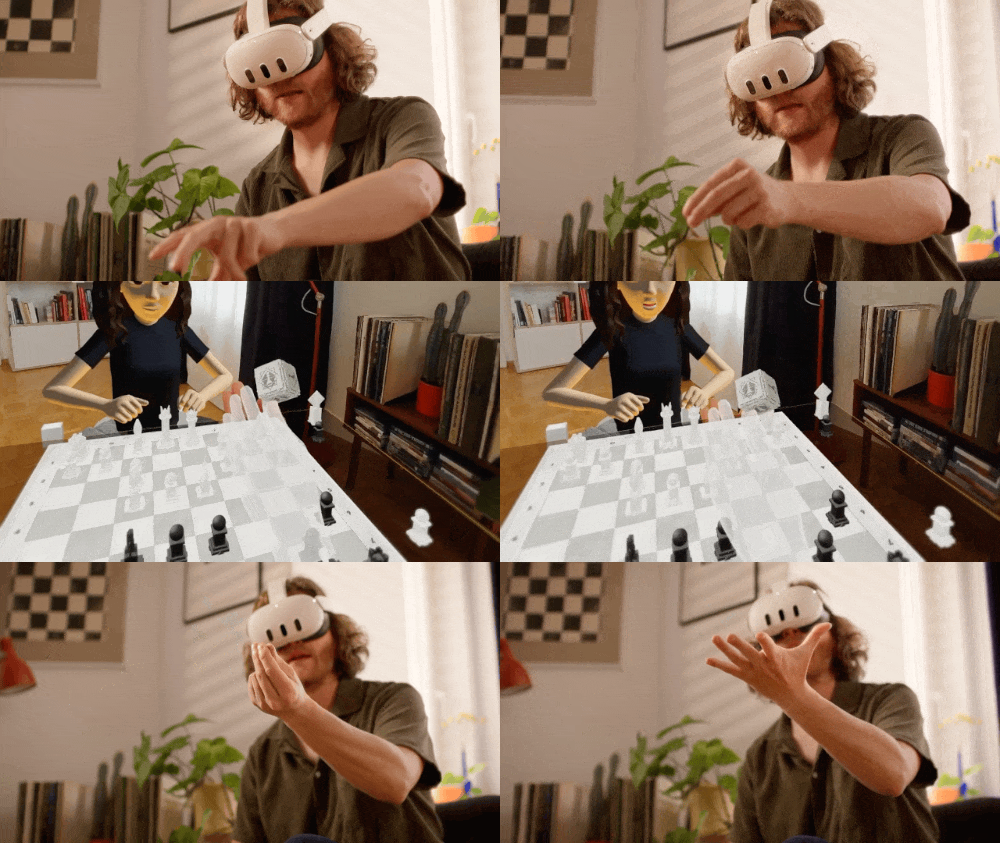
With hand tracking, Chess Club lets players reach for pieces, pick them up, and place them naturally on the board.
The lesson for developers is clear: hand tracking works best when the interaction already wants to be physical. In Chess Club, moving a piece with your hand did not need to be over-explained. It felt like chess.
The Magical Details
On paper, hand interactions for chess sound simple: pick up a piece and move it to another square. In practice, the details mattered.
"The gameplay design was very obvious," Pichardo García says. "However, we really paid attention to the magical details, like where exactly you could grab the pieces from and the physics of the interactions."
Those details became central to the experience. If grabbing a piece felt wrong, the whole illusion weakened. If the physics felt right, the player could accept the virtual board more easily.
"The biggest detail that made hands feel right was the physics when grabbing pieces," Pichardo García says.
Menus also needed to feel native to the hand-tracking experience. Instead of relying only on flat panels or controller-style navigation, Odders connected UI to the pieces themselves.
Precision, Placement, and Fairness
Chess is forgiving in one way and unforgiving in another.
The movements are not usually fast, unless you are playing at a very high level. But precision still matters. A piece has to land on the right square. A mistaken move can change the game.
"Chess needs precision because you have to place a piece on exactly the right square," Pichardo García says. "After a lot of trial and error, and after adding an undo button, we got the interaction to a place where it felt good."
The early implementation required both Interaction SDK (Unity | Unreal) support and custom development. As the SDK improved, Odders re-implemented parts of the system to take advantage of better capabilities. These improvements helped hand tracking precision become consistent enough for a game like chess, where movement is slower but placement still needs to feel reliable.
"The good thing about chess is that movements are not that fast," Pichardo García says. "And after a few SDK iterations, the precision was good enough. But it did come with challenges."
For edge cases, Odders chose clarity over risk. If tracking was lost mid-move, the move was canceled rather than allowing the game to execute something the player did not intend. The undo button also helped reduce frustration, especially when hand tracking precision was not as strong as it is today.
"Tracking loss would result in a canceled move since that was leading to the biggest frustrations for the players," Pichardo García says. "Adding the undo button also helped a lot when the precision wasn't as great as it is right now."
That is a useful hand-tracking lesson: when the system is unsure, do not punish the player. Give them a way back.
Today, developers implementing hand tracking for the first time in Unity can leverage tools like Building Blocks for faster configuration. And when it comes time to iterate and test, new MCP-compatible tools like Meta XR Operator enable AI coding agents like Muse Code to interact with your experience directly in the editor, make adjustments, and verify fixes.
Beyond the Board
Once players had hands, they were excited to enjoy chess as an experience, not just moves on a board.
They balanced pieces. They moved things around. They explored the board outside normal gameplay. Odders leaned into that behavior with physics and playful gestures.
"That's where we replied with lots of fun physics," Pichardo García says. "We added emoji reactions to different hand gestures because players were already expressing themselves with their hands. It made the game feel more social and more playful."
The Mixed Reality Gambit
Hand tracking made Chess Club feel more natural. Mixed reality made it feel more personal.
Players could already play in fully immersive VR, but mixed reality changed the context. The board could sit on the player's actual table. The room stayed visible. The experience became less isolating and more everyday.
 It was the best hand-tracking experience we've created. Being able to stay present with my family at home while playing Chess Club in mixed reality was an incredible feeling.
Jaime Pichardo García
Chief Strategy Officer, Odders Lab
That presence matters for a slower game like chess. Full immersion can be powerful, but not every experience needs to remove the player from their surroundings.
"Immersion is great in many cases," Pichardo García says. "However, there are slow games, and especially board games, where just enhancing your surroundings with a little virtual game makes it so much more cozy and enjoyable."
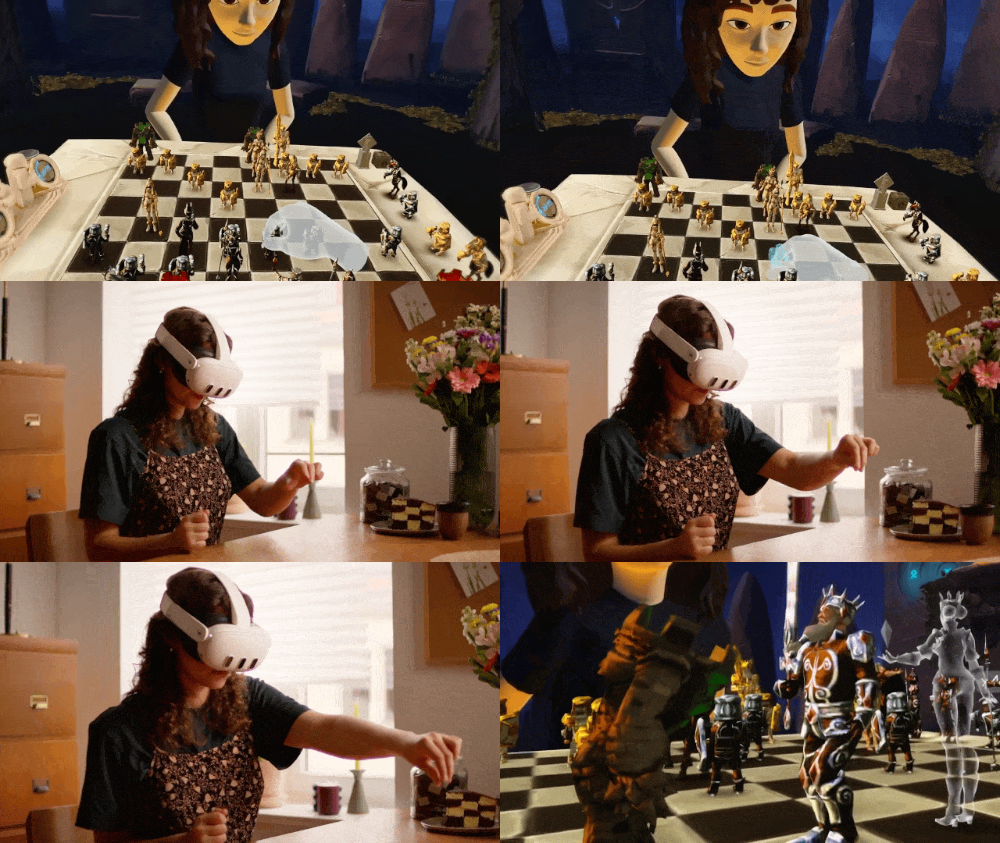
In mixed reality, Chess Club lets players place the board in their real space and interact with pieces using natural hand movements.
Designing for mixed reality also changed the interaction standard. In full VR, developers can get away with more artificial behaviors because the whole world is virtual. In mixed reality, players can see their real surroundings, so virtual objects need to behave more like they belong there.
Player Response: Opening the Board to Everyone
When hand tracking launched, Chess Club stood out.
"Reviews and player sentiment definitely improved considerably," Pichardo García says. "It was one of the few games offering it at the time."
For roughly three weeks around the update, hand tracking became the top topic in the Chess Club community, and Odders Lab saw twice as many positive reviews mentioning hands. The latest hand tracking update brought that response back, with another wave of positive reviews as the experience became more comparable to controllers.
Usage followed the same pattern. Around launch, about 25% of players used hands. That later stabilized near 15%, then rose back to 25% around the latest update before settling again. Many players try hands a few times, then return to controllers, especially competitive players who want maximum precision. More casual players continue to gravitate toward hands.
"Even though the precision errors were not super common, you could see more casual players going for hands and those hardcore players picked controllers most," Pichardo García says.
Mixed reality showed similar strength without changing the core rhythm of play. Session duration is nearly the same between VR and MR, with players averaging about 90 minutes of play time per month and 18 minutes per session.
For chess, mixed reality does not need to reinvent the loop. It makes the experience more approachable, comfortable, and naturally integrated into the player's real space.
The biggest shift was who people shared it with.
"What we noticed was an increase of comments and reviews where they chose Chess Club as one of the first experiences people showed their friends and family using hands," Pichardo García says. "That stuck especially with older players."
For Odders Lab, that is the practical value of hand tracking in an established title. It did not replace controllers. It expanded the experience: controllers for competitive precision, hands for a more familiar way in, especially for casual players, families, older players, and VR newcomers.
"The magical feeling of it resembling the real experience so truly well, and the fact a large percentage of players use it regularly without precision complaints," Pichardo García says.
That told Odders Lab the investment was worth it.
A Long-Running Game Built to Stay Relevant
Chess Club launched in 2021, and Pichardo García designed it to keep earning attention over time.
With a team of about 10 people, the game has reached more than 100,000 installs and more than 12,500 ratings and reviews with a 4-star average across platforms. Its audience is mostly in the US, UK, and Canada.
For Odders Lab, the game's staying power comes from a timeless core experience supported by regular updates, discount campaigns, and retention features. Daily puzzles became especially important, giving players a simple reason to return even when they are not sitting down for a full match.
"New friends getting headsets and now the daily puzzles keep players coming back," Pichardo García says. "Our philosophy is to always give players something new to come back for. That can be daily puzzles, events, timed activities, or rotating content through weekly missions."
That is a clear live-ops lesson for other developers: a timeless core loop helps, but players still need reasons to return today. Whether you're updating a long-running title like Odders Lab or a recent launch, platform engagement tools like Developer Posts and User Notifications can help you communicate new game modes or cosmetics to a wide audience and spark higher retention.
Building with Meta Tools
Odders mainly used the Meta Interaction SDK (Unity | Unreal) for the hands implementation. In the beginning, Pichardo García still had to do a lot of custom work because both the feature and the desired experience were still evolving.
"As the SDK improved, we also had to re-implement parts of our system," Pichardo García says. "That took work, but it also helped us get closer to the experience we wanted."
For Chess Club, those improvements mattered because the input sits between comfort and precision. The lesson is not simply "use the SDK." It is to keep improving with the platform. As tools get better, established titles can revisit features that were previously harder, less precise, or more expensive to support.
The Next Move for Chess Club
Odders is continuing to support Chess Club with more daily puzzles, more variety, and a stronger focus on community.
"We keep working on more daily puzzles for the game to add variety and focusing on building community so we can increase concurrency of players in most time ranges," Pichardo García says.
That community focus matters for a multiplayer chess game. ELO ranking, AI opponents, and flexible matchmaking help cover different play styles and different concurrency levels, but a stronger community gives players more reasons to return.
Odders is also thinking about hands and mixed reality beyond Chess Club. The team continues to update another mixed reality hand-tracking game, Make It Stable, and sees mixed reality as an area where familiar real-world actions can become more powerful inside a headset.
As for the future of VR and mixed reality, Odders Lab keeps the answer simple.
"Magical," Pichardo García says. "Many games already offer incredible levels of immersion, and this is the worst they will ever be."
That optimism fits the Chess Club story. The game began as a classic experience adapted for VR, then became more natural through hands, more personal through mixed reality, and more durable through ongoing updates.
5 Takeaways for Adding Hands to an Established Game
1. Ask if the game is actually better with hands
Odders did not add hand tracking just because the feature existed. They added it because chess is already physical, deliberate, and familiar.
Takeaway: Before adding hands to an established title, ask: is this actually better with hands? If the answer is not obvious, the feature may not be worth the tradeoff.
2. Let the real-world action guide the design
Chess pieces already tell players what to do. You reach, grab, move, and place. Odders leaned into that instead of inventing a gesture language.
Takeaway: Hand tracking works best when the virtual action mirrors something players already understand from the real world.
3. Make precision forgiving
Chess requires exact placement, so Odders added practical safeguards like canceled moves and an undo button. The goal was not just precision. It was confidence.
Takeaway: If tracking is lost or input is ambiguous, avoid executing an action the player did not intend. Give them a way to recover.
4. Do not ignore physics
For Chess Club, the feel of grabbing pieces was not a small detail. It was central to immersion.
Takeaway: Players may not be able to explain why an interaction feels wrong, but they will feel it. Invest in physics, feedback, and game feel where the hand meets the object.
5. Make players feel cool
Odders' simplest advice is also the most useful.
Make them feel cool using it. You need to make up for the lack of haptics, so if you will be offering it or using it as the main way of interacting with your game, make them feel cool.
Jaime Pichardo García
Chief Strategy Officer, Odders Lab
Takeaway: Smooth, intentional, satisfying interaction matters more than perfect realism. Better to create a great-feeling experience than to mimic reality and fall short.
Start Building Hands-First Experiences
Chess Club shows how an established title can adopt hand tracking and mixed reality without losing what made the game work in the first place. Odders Lab kept the core of chess intact, then used platform features to make it more natural, more social, and more approachable for casual players, families, and VR newcomers.
Use these resources to start building your own hands-first experience in VR:
- Meta XR SDK: includes Meta Interaction SDK and Meta XR Platform SDK to build hand and controller interactions, add invites, leaderboards, in-app purchases, and multiplayer platform features.
- Hand tracking documentation: design and implement hand-first input.
- Building Blocks: pre-configured, modular components that let you drag and drop core hand-tracking features.
- Meta XR Operator: an OpenXR AI bridge for simulating headset telemetry and hand-pose tests without physical hardware.
- Meta Quest Developer Hub: test, debug, and optimize on-device.
- Meta Horizon Start Program: connect with other developers and access support resources.
Chess Club is available in the Store on Meta Quest. For the latest updates, follow us on X, Facebook, and LinkedIn, subscribe to our monthly VR developer newsletter, and join the conversation in the Meta Developer Forum.
TAGS
Quest
Games
Experiences
Apps
Design
Optimization
Streaming
Explore more
Hand Physics Lab
Table Troopers

How Owlchemy Labs Cut CPI by 95% on Meta Quest

Support and legal
Support and legal
Support and legal
English (US)
© 2026 Meta